
Eguzkilore: The Basque Sun Flower That Keeps Evil Spirits from Your Door
How do you protect your home from whatever might come to the door while you sleep? For generations in the Basque Country, the answer was the Eguzkilore, a mysterious silver “flower of the sun” believed to keep witches and evil spirits outside until dawn. And according to legend, it did not frighten them away: it kept them busy with a task they could never finish before sunrise.
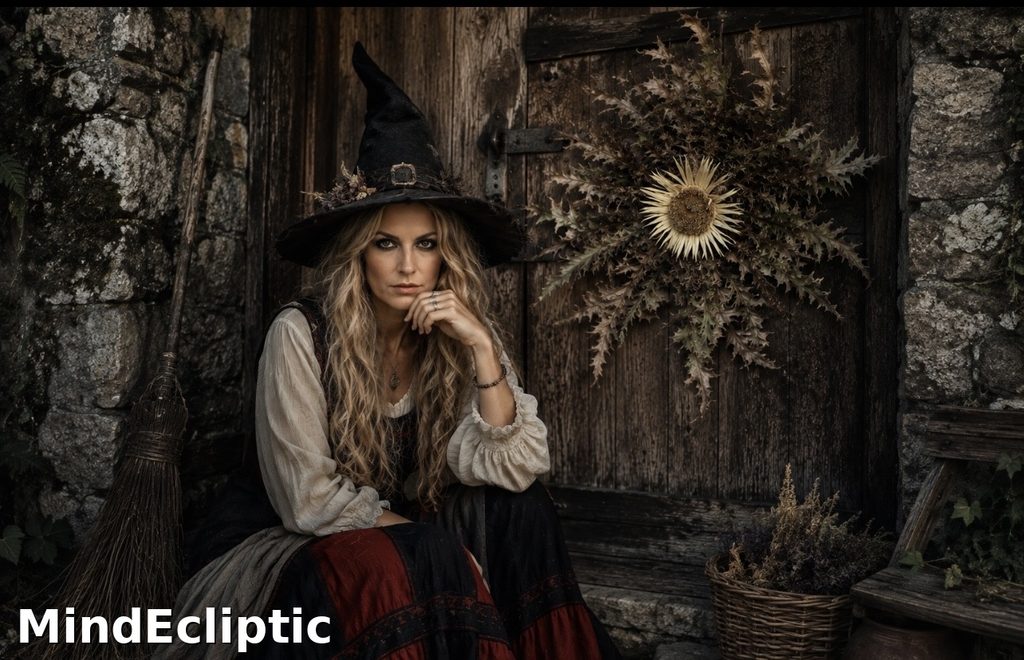
On the heavy wooden door of an old Basque farmhouse, or baserri, you may notice something unusual: a large, dried, silver-white flower fixed above the entrance. At first glance, it resembles a frozen sun.
This is the Eguzkilore, literally the “flower of the sun,” one of the most recognizable protective symbols in Basque culture. For generations, it has been placed on the doors of homes as protection against evil, storms and spirits of the night. The Basque Government still describes the Eguzkilore as a deeply rooted element of Basque cultural heritage and popular tradition.
But there is a stranger part to the legend. In one version of the folklore, a witch or malevolent nocturnal being arriving at a protected house cannot simply walk past the flower. The creature becomes trapped in an impossible task: it must count the numerous elements of the Eguzkilore before crossing the threshold. Dawn arrives before the count can be completed, forcing the visitor of the night to retreat. Other versions say the flower fools witches into believing that the Sun itself has already risen.
Behind this supernatural guardian, however, lies a real and rather remarkable plant.
What Is an Eguzkilore? The Real Plant Behind the Legend
The plant traditionally identified with the Eguzkilore is Carlina acaulis, commonly known in English as the carline thistle or stemless carline thistle.
It belongs to the Asteraceae, the same enormous botanical family that includes daisies, sunflowers and dandelions. It grows as a low, spiny rosette, often appearing to sit directly against the ground. At its center is a large flower head surrounded by striking silver-white structures that give it its unmistakable solar appearance.
The Flower That Is Not Quite a Flower
The first illusion of the Eguzkilore is botanical. What appears from a distance to be a circle of long silver petals is actually formed by involucral bracts surrounding the flower head. Inside them sits a central disc made up of numerous small florets. Botanical descriptions of Carlina acaulis distinguish this central flower head from the conspicuous silvery-white bracts around it.
These stiff, papery structures also explain why a dried Eguzkilore can retain its dramatic star-like appearance for a very long time.
Unlike the soft petals of many familiar garden flowers, its silvery rays are already structurally tough. Once dried, the entire head can remain remarkably recognizable, one reason the plant became so suitable for hanging above a doorway.
And there is another unusual property hidden inside those apparently lifeless rays.
A Natural Weather Forecaster
The bracts of Carlina acaulis are hygroscopic: they respond physically to moisture. In warm, dry conditions, the silvery bracts spread outward and expose the flower head. As humidity increases, they bend inward, helping to shelter the florets and their pollen from rain. Scientific descriptions of the mechanism show that this movement is passive and moisture-driven rather than dependent on active metabolism.
The response can even continue in detached plant material. This unusual behavior gave the carline thistle a reputation in parts of Europe as a rustic natural hygrometer or “weather-glass.” Open rays suggested dry weather; a closing flower indicated increasing moisture and possible rain.
For the Eguzkilore, the coincidence is almost too perfect. A flower associated in Basque tradition with protecting the household from storms is, biologically, a structure capable of responding to the atmospheric moisture that accompanies changing weather.
The botany does not prove the legend, of course. But it makes the choice of this particular plant as a household guardian considerably more intriguing.
A Rare Mountain Flower That Now Needs Protection
In the Basque Country, the Eguzkilore is not only a cultural symbol but also a rare mountain plant. Local populations of Carlina acaulis are limited to particular mountain areas, and official environmental documents warn that its striking flower heads can make it vulnerable to collection.
There is a beautiful irony in this: the flower that once protected people now needs people to protect it.
Today, the familiar sun-shaped Eguzkilore also appears in jewelry, metalwork and decorative objects, allowing an ancient Basque symbol to live on without picking the wild flower from the mountains.
Why Is It Called Eguzkilore? The Flower of the Sun
The name itself reveals the key to the entire legend. In Basque:
Eguzki means Sun.
Lore means flower.
Eguzkilore therefore literally means “flower of the Sun.” The translation is also used by the Basque Government when explaining the cultural significance of the plant. Its appearance makes the association easy to understand.
The pale rays radiating from the darker center create something remarkably similar to a solar disc. Dried and fixed to a dark wooden door, the resemblance becomes even more dramatic.
But in Basque mythology, the connection between the Eguzkilore and the Sun goes much deeper than shape. To understand why a thistle could protect an entire household, we have to return to Amalur, the Earth Mother, and to a world in which night belonged to beings humans could not control.
The Solar Myth: Amalur, Eguzki and the Birth of Eguzkilore
Basque mythology preserves a world filled with mountains, caves, rivers, witches, lamias and supernatural beings. Official Basque tourism material describes a cosmology in which nature, darkness, light, the Moon and the Sun all carry mythological significance, with Ama Lur, Mother Earth, at its center.
One traditional story connects Amalur directly with the birth of the Eguzkilore.
Human beings were afraid of the creatures that emerged in darkness and asked Amalur for help. She first gave them the Moon, Ilargi, so that the night would no longer be completely dark. Yet the Moon was not enough.
The forces of the night remained, and humanity still needed something stronger. In the broader solar tradition, Eguzki, the Sun, became the great power before which the creatures of darkness had to retreat.
But the Sun brought another problem with it: every evening it disappeared. According to a version recorded by the official tourism service of Biscay, Amalur ultimately gave humanity the Eguzkilore as additional protection against malevolent beings. In expanded retellings of the myth, the extraordinary resemblance between the flower and a solar disc explains its purpose. If the real Sun could protect humans during the day, its image could remain with them after sunset.
A mountain thistle had become an earthly representative of the celestial Sun. The real Eguzki might disappear behind the mountains each evening, but its likeness could remain behind, fixed to the doorway throughout the dangerous hours of darkness.
How Does Eguzkilore Magic Work?
The most fascinating element of Eguzkilore folklore is that the flower does not simply repel evil through some undefined magical force. Tradition gives the protection a mechanism. And there is more than one version.
The False Sun
One of the best documented interpretations comes from Zerain in Gipuzkoa.
According to material collected in the Ethnographic Atlas of the Basque Country, witches encountering an Eguzkilore on the door believe that they are seeing the Sun. If the Sun has appeared, then their permitted time of activity, the night, must already be over.
They therefore do not enter the house. The logic is beautifully simple. The plant does not need to overpower the supernatural visitor; it only has to deceive it. A dried mountain thistle becomes a false dawn.
The Impossible Count
Another widespread version of the legend is stranger. Here, the supernatural visitor cannot cross the threshold until it has counted the many leaves, bracts, hairs or other elements of the Eguzkilore. The task takes too long.
The creature remains outside as the hours pass, occupied by a flower whose intricate structure seems designed to resist a simple count. Before the task can be completed, morning arrives, and the dangerous visitor must return to its nocturnal refuge.
Popular versions of the tradition associate this counting motif with sorginak, the witches of Basque folklore, as well as lamiak and other beings of the night.
Some modern retellings describe the creature as fascinated or almost hypnotized by the impossible count. “Hypnosis” is better understood as an interpretation of the legend than as a literal historical description, but the image captures its peculiar logic rather well.
The Eguzkilore does not defeat evil by force. It defeats it with an impossible task.
The creature has the entire night to reach the people inside the house, yet a flower on the door consumes those hours one by one. By the time the count no longer matters, neither does the creature’s power. Dawn has arrived.
Who Was Eguzkilore Supposed to Keep Away?
The beings associated with the Eguzkilore vary between local traditions. Basque folklore never needed a single monster to explain everything that might wait beyond the safety of a house after dark.
Sorginak
The sorginak are the witches of Basque folklore. Ethnographic records specifically document the use of Carlina acaulis on house doors as protection against witches, including in Ataun.
But Basque supernatural tradition should not be reduced to the familiar image of the witch from later European fairy tales. Sorginak belong to a much larger mythological landscape involving magic, nocturnal danger, caves, mountains and older systems of belief.
They are inhabitants of a world in which the boundary between the natural and supernatural is not always sharply drawn.
Lamiak
The lamiak are another famous group of beings in Basque folklore.
They are generally represented as female supernatural creatures connected with places such as rivers, springs and caves, although their descriptions and stories vary considerably by region. Official Basque tourism material places lamias alongside witches and other fantastic creatures within the traditional mythological landscape.
Popular versions of the Eguzkilore legend include both sorginak and lamiak among the beings delayed by the impossible counting task.
Spirits of the Night
Some traditions are less specific.
The Ethnographic Atlas records the flower being used in places such as Pipaón and Arrasate to protect houses from malos espíritus: evil spirits.
The Eguzkilore therefore functions less like a weapon against one particular mythological creature and more like a general guardian against whatever belongs outside when darkness falls.
Why the Door? The Magic of the Threshold
An Eguzkilore is not traditionally hidden somewhere deep inside the house. It guards the entrance. Ethnographic evidence records it attached to the main door of the farmhouse, above or around the entrance, and in some communities on the interior side of the door. Flowers were also placed on beams in stables or agricultural buildings.
That location matters. A threshold is one of humanity’s oldest symbolic boundaries. It is neither fully outside nor fully inside, but the narrow point where one world becomes another.
It separates:
- inside from outside;
- family from stranger;
- safety from danger;
- the inhabited world from the wilderness;
- the ordinary from the supernatural.
That makes the doorway a natural place for protective customs. The danger does not have to be destroyed somewhere out in the landscape; it only has to be prevented from crossing into the protected human space.
The Eguzkilore occupies precisely this boundary.
A witch may still exist beyond the door. A lamia may still inhabit the river. A storm may still move across the mountains. The night itself is not abolished.
The charm has a more intimate purpose: whatever is outside must remain outside.
That is why the image of the silver flower on an ancient baserri door remains so powerful. It is not merely decoration placed on a house. It marks the point beyond which the darkness is not welcome.
More Than Witches: Storms, Lightning and Misfortune
The protective role of the Eguzkilore was not limited to supernatural intruders.
Ethnographic records from Lekunberri, for example, describe placing the flower on the door as protection against lightning. Elsewhere, it was associated with defending the household against witches, evil spirits and other misfortunes.
The Basque Government likewise summarizes the traditional Eguzkilore as a household protector against evils, storms and spirits of the night.
Here the mythology unexpectedly meets botany again. The real plant changes its shape according to moisture in the air. Before or during wet conditions, its hygroscopic bracts move inward; under dry conditions, they spread open like a bright silver sun. There is no reason to turn that biological mechanism into supernatural evidence, nor can we assume that it caused the protective tradition.
Still, the parallel is remarkable.
The same flower that responds visibly to changing weather became a symbol invoked against dangerous weather. Long before anyone could explain the mechanics of hygroscopic plant tissue, people could observe the flower opening beneath a dry sky and closing as moisture increased.
Whether that observation influenced the folklore is impossible to know. The two histories, botanical and mythological, simply meet in the same extraordinary plant.
Eguzkilore Today: An Ancient Symbol in Modern Basque Culture
The Eguzkilore did not disappear when old beliefs about witches and nocturnal spirits became less literal. Instead, its meaning changed.
The Ethnographic Atlas of the Basque Country notes that Eguzkilore flowers can still be seen on many doors, sometimes functioning as decorative elements as well as echoes of their older protective meaning. It also records younger generations continuing to place them on houses.
Meanwhile, the flower has moved beyond the farmhouse.
Its solar form appears in jewelry, metalwork, decorative objects and contemporary representations of Basque identity. The Basque Government describes it today not only as a protective symbol but as an emblem associated with identity, belonging and cultural transmission between generations.
That modern transformation is particularly important because wild populations in parts of the Basque Country are limited and collecting conspicuous flower heads has historically been identified as a conservation risk.
The old symbol therefore faces an unusual twenty-first-century challenge. Preserving the tradition should not require damaging the plant that created it.
A silver pendant, carved wooden disc, ceramic ornament or metal Eguzkilore can carry the same unmistakable image without removing another living specimen from the mountains.
The guardian survives. So can the flower.
The Hidden Symbolism of Eguzkilore
Beyond its documented folklore, the Eguzkilore lends itself to a striking symbolic interpretation. Not every meaning we can see in the story today was necessarily stated explicitly by the people who once fixed these flowers to their doors. But the structure of the legend contains a remarkably coherent set of opposites.
The Sun represents light, life and cosmic order.
The night represents uncertainty and the domain of beings outside ordinary human control.
The doorway represents the boundary between the protected world of the household and everything beyond it.
The Eguzkilore brings an image of sunlight down to Earth and places it directly on that boundary.
Then there is the strangest element of all: counting.
The supernatural visitor is not struck down by the flower. Instead, its attention becomes caught in a repetitive task.
One element follows another. The intricate structure demands attention while the hours continue to pass. The creature spends the limited time in which it possesses power attempting to overcome something as apparently harmless as a flower. This gives the protective magic of the Eguzkilore an unusual character.
Evil does not always have to be confronted directly. Sometimes it only has to be delayed. That idea changes the entire legend.
The night is powerful, but temporary. The guardian on the door does not need to defeat darkness forever; it needs only to prevent it from crossing the threshold until the natural order changes again.
Morning will come without the flower’s help. The Eguzkilore simply keeps watch until it does.
The Sun That Never Sets
Imagine the old farmhouse once more. Night has settled over the mountains. The door is closed, and beyond it lies a landscape that, for generations of Basque storytellers, belonged not only to animals and travelers but to witches, lamiak, wandering spirits and things without ordinary names.
Above the threshold hangs a dried mountain thistle.
Botanically, it is Carlina acaulis: a remarkable plant whose silvery bracts respond to moisture, opening into a solar disc when conditions are dry and folding inward when humidity rises.
Ecologically, its localized Basque populations remind us that even powerful cultural symbols can be vulnerable in the natural world.
But on the door of the baserri, it becomes something entirely different. The real Sun has disappeared behind the mountains, yet its image has been left behind.
Perhaps the creature approaching the house sees the silver disc and mistakes it for dawn. Perhaps it stops before the threshold and begins the impossible count, losing the remaining hours of darkness among the intricate details of the flower.
Inside, the household sleeps. Outside, the night slowly runs out.
And when the first light finally reaches the mountains, the little Sun on the door has done its job.
Only official channels listed here: About MindEcliptic
If this article was helpful and you’d like to say thank you, you can buy me a coffee here.