The 22 Main Energies of the Destiny Matrix (Part III)
Some Destiny Matrix energies are easy to recognize. Others take us into more complex territory: desire, control, fear, ego, collapse, illusion, and the need for freedom. But the final eight energies are not only about challenge. They are also about talent, visibility, awakening, completion, and the courage to live beyond old limits.
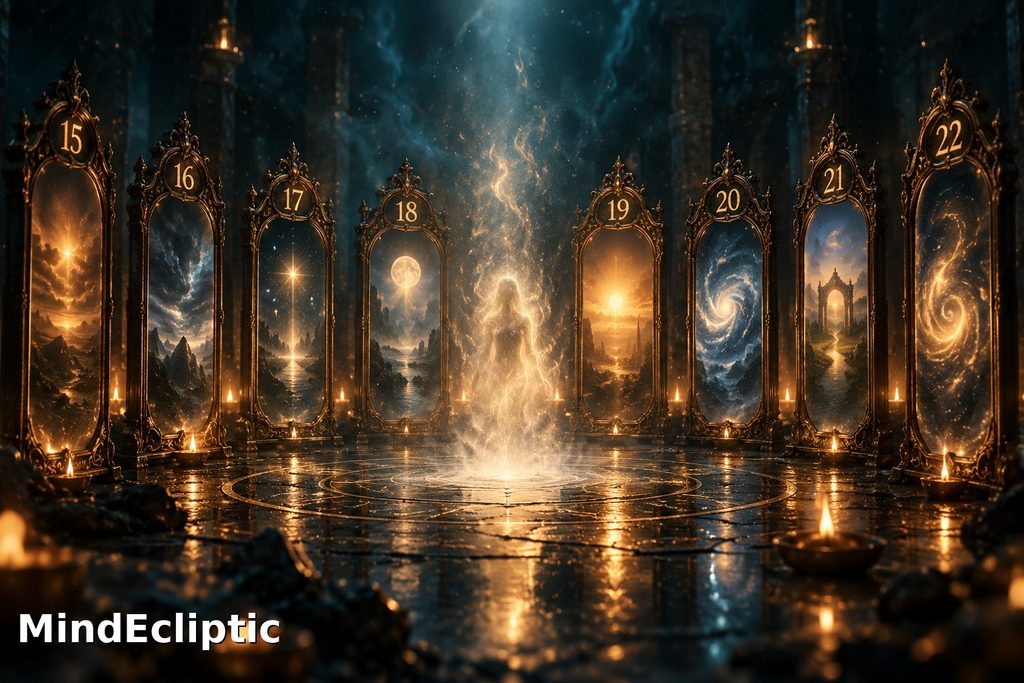
In Part I, we explored Energies 1–7. In Part II, we continued with Energies 8–14. Now we complete the cycle with Energies 15 through 22: The Devil, The Tower, The Star, The Moon, The Sun, Judgement, The World, and The Fool.
The final part of our guide brings us to some of the most psychologically intense and recognizable archetypes in the Destiny Matrix. Here we move from desire and material power through destruction, talent, intuition, success, ancestral themes, completion, and finally freedom. How to Read a Destiny Matrix Chart: A Complete Beginner’s Guide.
As in the first two parts, we are deliberately looking at the core character of each energy rather than its meaning in one specific position of the Matrix. Energy 18 in the Center, for example, will not be interpreted exactly like Energy 18 in relationships, finances, talents, the Karmic Tail, or another area of the chart. The position tells us where the energy operates; the archetype tells us what kind of force is present. This position-dependent principle is central to reading the Matrix rather than simply looking up numbers.
The purpose of this three-part series is therefore to build the foundation first: the personality tendencies, positive and negative expressions, masculine and feminine manifestations, and Tarot connection of all 22 energies.
And the final eight bring us to the end of the archetypal journey.
Energy 15: The Devil
Core themes: desire, magnetism, material power, passion, sexuality, ambition, money, temptation, attachment, influence.
Energy 15 is the archetype of desire and material power.
The Devil is one of the most misunderstood energies because its name immediately sounds negative. But in the Destiny Matrix, Fifteen is not simply about temptation or destructive attachment. In its positive expression, it can represent enormous charisma, ambition, passion, material instinct, psychological insight, and the ability to understand what people genuinely want.
Whether Energy 15 is expressed positively or negatively, one of its central lifelong themes is the relationship with temptation, passion, desire, and personal weakness. For this archetype, spiritual and personal development can therefore be especially important. The task is not to eliminate desire, but to learn how to direct it consciously, work with habits, strengthen self-control, and prevent instinct or appetite from becoming the force that makes decisions.
Energy 15 in the Positive
In its positive expression, Energy 15 describes a magnetic, passionate, ambitious, perceptive, and powerful personality. The Devil understands desire.
It may have an intuitive feel for money, influence, attraction, business, negotiation, sexuality, status, or any environment where people are motivated by strong wants rather than abstract principles.
This can create considerable material potential. Fifteen is not necessarily uncomfortable with wealth, pleasure, ambition, luxury, status, or power. Where another archetype might feel guilty for wanting more, the positive Devil can acknowledge desire openly and use it constructively.
There can be a genuine appreciation for quality, luxury, beautiful surroundings, expensive things, and visible signs of achievement. In a balanced expression, this does not necessarily become materialism; it can simply reflect a strong connection with the physical and material side of life.
Charisma is another major theme.
Energy 15 can be extremely compelling. It may attract attention without actively demanding it and often understands how to influence a room, a conversation, or another person’s emotional state. There can also be strong psychological insight. The Devil notices people’s hidden motivations, contradictions, weaknesses, temptations, and unspoken wishes, partly because it is willing to look at aspects of human nature that more idealistic energies might prefer to ignore.
This understanding of temptation can also work constructively. A mature Fifteen may be particularly capable of recognising destructive patterns in others and, in some interpretations of the Destiny Matrix, can become someone who helps other people confront dependencies, compulsions, or self-destructive habits precisely because this archetype understands how powerful desire can become.
Passion can be a major creative and professional resource. When Fifteen wants something strongly and channels that desire consciously, it can demonstrate remarkable persistence and strategic ability. At its best, Energy 15 does not deny the material or instinctive side of life. It learns to own desire without becoming owned by it.
Energy 15 in the Negative
The shadow appears when desire becomes dependency and power loses its boundaries. What the person enjoys begins to control them.
This may manifest through unhealthy attachments, compulsive behaviour, jealousy, obsession, excessive materialism, manipulative relationships, power struggles, or the constant need for stronger stimulation.
Alcohol, other addictive behaviours, gambling, sex, money, attention, status, or any other source of intense gratification may become especially difficult to regulate when the Fifteenth Energy is expressed destructively. Within the Destiny Matrix framework, the issue is not the specific object of desire but the loss of self-control in relation to it.
The negative Devil can also become highly controlling and manipulative. Because it understands desire so well, it may use attraction, money, guilt, sexuality, fear, status, emotional pressure, threats, or another person’s vulnerabilities to get what it wants.
Manipulation can escalate into exploitation. In its most destructive symbolic expression, Energy 15 may be associated with aggression, cruelty, coercive behaviour, humiliation, or sadistic tendencies: situations in which power and another person’s vulnerability become sources of gratification.
This should not be interpreted as meaning that a person with Energy 15 is inherently violent or destined to commit abuse. The Destiny Matrix cannot establish criminal behaviour from a number. Rather, these are descriptions of the extreme shadow traditionally associated with an archetype centred on desire, domination, and uncontrolled instinct.
Relationships can become transactional: What can you give me? What do I get from keeping you close?
For personal gain, the shadow Fifteen may justify deception, betrayal, infidelity, blackmail, emotional manipulation, or exploiting another person’s dependence. The goal begins to matter more than the means used to reach it. Ambition may also lose its boundaries. Success, money, appearance, sexual validation, luxury, or social power can become proof of personal worth rather than simply parts of life.
Within esoteric interpretations, another shadow sometimes attributed to The Devil is the misuse of occult or magical practices for control, coercion, revenge, or personal advantage. Here again, the central symbolic issue is the same: using power to dominate rather than taking responsibility for it.
Another shadow is denial.
The person may insist that they are completely free while repeatedly returning to the same destructive attachment, habit, relationship, or pattern. This is one of the central paradoxes of The Devil: the chain often remains because some part of the person still wants what the chain provides.
The opposite extreme can also appear. A person may become frightened of their own ambition, sexuality, material desires, or personal power and try to suppress them completely. Repressed desire does not necessarily disappear; it may simply operate unconsciously.
For Energy 15, spiritual development therefore becomes particularly meaningful. The challenge is not to become “pure” by denying every passion, but to recognise personal weaknesses, work consciously with habits and impulses, and make sure that desire remains a source of energy rather than becoming a master.
The central challenge of Energy 15 is therefore to develop passion without addiction, influence without manipulation, ambition without obsession, power without cruelty, and freedom through honest recognition of what truly controls you.
Masculine and Feminine Expression
Through a more masculine or outward-directed principle, Energy 15 may appear as ambition, competitiveness, strong sexuality, financial drive, strategic influence, charisma, dominance, and the desire to acquire tangible power.
Through a more feminine or receptive principle, The Devil may express itself through magnetism, sensuality, emotional influence, psychological insight, attraction, strategic social intelligence, and a strong awareness of what other people desire.
These expressions are not determined by biological sex. In either form, Fifteen carries substantial personal power. Its task is not to eliminate that power, but to use it consciously.
Connection with Tarot
In Tarot, The Devil represents desire, attachment, temptation, instinct, materiality, sexuality, power dynamics, and the parts of ourselves we may prefer not to acknowledge.
Its chains are one of its most important symbols. They raise a difficult question: Are you truly trapped, or are you still participating in what binds you?
The Destiny Matrix expands this archetype into themes of material power, magnetism, passion, ambition, influence, temptation, attachment, self-control, and the conscious relationship with desire.
At its best, Energy 15 does not pretend to have no shadow. It knows its shadow well enough not to become its servant.
Energy 16: The Tower
Core themes: transformation through crisis, truth, destruction, liberation, rebuilding, sudden change, independence, breakthrough, awakening, control.
Energy 16 is the archetype of collapse that reveals the truth.
The Tower appears when something can no longer remain standing in its existing form. False structures, outdated beliefs, unstable relationships, restrictive systems, or identities built on illusion may suddenly become impossible to maintain.
There is a powerful inner pull toward destruction, change, and reconstruction in this archetype. Energy 16 does not simply want to break something for the sake of breaking it. At its healthiest, it wants to clear what no longer works and build something stronger in its place.
Energy 16 in the Positive
In its positive expression, Energy 16 describes a courageous, independent, resilient personality capable of surviving major disruption and rebuilding quickly. The Tower often has little patience for structures that no longer make sense.
These can be true revolutionaries and stereotype-breakers: people with original thinking who question established assumptions, challenge outdated systems, and are willing to do things differently even when everyone else considers the old way normal.
Their words can carry unusual force. Energy 16 may communicate with intensity and conviction, and what such a person says can strongly affect other people, provoke reflection, or trigger change.
There is often an instinctive desire to tear down what is obsolete and build something stronger in its place. In a very literal symbolic sense, The Tower is the person who could knock down an old house and rebuild it from the foundation because repairing the weak structure no longer seems worthwhile.
Change itself can be energising.
Where another person may fear disruption, a positive Sixteen can actually enjoy the process of transformation. It may feel most alive when restructuring, renovating, reforming, redesigning, or creating something new from what has already collapsed.
This can produce innovators, reformers, crisis-solvers, unconventional thinkers, and people who are unusually capable when circumstances suddenly fall apart. Where others may freeze during a crisis, Sixteen may become clearer.
At the same time, the positive Tower is not necessarily chaotic. Paradoxically, many Sixteens can be highly inclined to plan, organise, and control circumstances carefully because they want enough structure to accomplish everything they have set out to do. Their attraction to radical change can coexist with a strong desire to keep the process itself under control.
Its relationship with truth can also be uncompromising. The Tower prefers an uncomfortable reality to a comfortable illusion. That makes this energy potentially liberating. It can break inherited patterns, leave environments that have become restrictive, challenge authority, abandon false identities, and create a completely new structure after the old one fails.
There can also be tremendous resilience.
The positive Tower learns from collapse rather than merely fearing it. Once it understands that rebuilding is possible, change becomes less threatening.
At its best, Energy 16 embodies the principle: If it cannot survive the truth, it was never stable enough.
Energy 16 in the Negative
The shadow appears when liberation becomes destruction.
The negative Tower may struggle to fit into established structures at all. Rules, institutions, hierarchies, commitments, and other people’s expectations can feel intolerably restrictive, even when those structures are not inherently harmful.
Rebellion then becomes automatic.
The person may challenge everything simply because it already exists, “fight for their rights” in every situation, provoke confrontations, or create scandals in order to resist any perceived attempt at control.
Another important shadow is not taking responsibility for one’s own words or destructive impact. The person may say something explosive, make a radical decision, or destroy a relationship and then behave as though the consequences belong entirely to everyone else.
Arguments escalate unnecessarily. Relationships are ended abruptly. Careers are abandoned impulsively. Bridges are burned. Stable situations begin to feel intolerable simply because calm lacks intensity.
The destructive energy of Sixteen can also turn toward the person’s own life.
Unhealthy habits, compulsive behaviour, self-sabotage, destructive relationships, or other harmful patterns may gradually damage both the individual and the people closest to them. The Tower can then become someone who repeatedly destroys stability, rebuilds, and destroys it again.
There can also be an unconscious tendency to create circumstances that justify another collapse. Internal tension grows, dissatisfaction accumulates, conflict is provoked, and eventually everything explodes, allowing the Tower to return to the familiar state of crisis and reconstruction.
Self-sabotage can become a major pattern. Instead of making a small correction early, the person waits until circumstances become unbearable and everything collapses at once.
At the opposite extreme lies fear of change.
A person may recognise that an old structure is failing but desperately try to preserve it because rebuilding feels terrifying. They remain in outdated relationships, jobs, identities, homes, or life situations long after change has become necessary.
This can even produce the symbolic pattern of the endless renovation: something has already been dismantled, but the person cannot complete the rebuilding process. The old no longer exists, while the new never fully arrives.
Another negative manifestation is building emotional walls.
The Tower may isolate itself, shut people out, become excessively defensive, or create such rigid boundaries that protection turns into disconnection. Instead of rebuilding a healthier structure, the person simply constructs higher walls.
Control can become another problem. Because Sixteen fears collapse, it may attempt to control every detail of life in order to prevent uncertainty. But excessive control often increases the very internal tension the person is trying to escape.
In some esoteric interpretations, prolonged inner tension within the shadow Tower is also associated with physical stress reactions or psychosomatic complaints. This should be understood as symbolic language about chronic stress and internal conflict, not as a medical prediction or a claim that Energy 16 causes illness.
The central challenge of Energy 16 is therefore to develop freedom without destruction, rebellion without chaos, control without rigidity, and the ability to change something consciously before life has to demolish it for you.
Masculine and Feminine Expression
Through a more masculine or outward-directed principle, Energy 16 may manifest as rebellion, decisive restructuring, crisis leadership, independence, confrontation with obsolete systems, strong opinions, and willingness to make radical changes.
Through a more feminine or receptive principle, The Tower may appear as profound inner awakening, emotional liberation, breaking inherited patterns, sudden shifts in self-understanding, strong boundaries, and the courage to rebuild identity after major change. These are archetypal tendencies rather than rules based on biological sex.
In either expression, Energy 16 is fundamentally concerned with truth and structure: What remains when what was false finally collapses?
Connection with Tarot
In Tarot, The Tower represents sudden revelation, rupture, collapse, liberation, and the destruction of structures that can no longer support reality.
Unlike Death, whose transformation can feel gradual or organic, The Tower is often experienced as abrupt. Something becomes visible all at once.
The Destiny Matrix retains this foundation through themes of crisis, revolutionary change, rebuilding, independence, truth, breakthrough, liberation from false structures, and the tension between destruction and creation.
The Tower’s lesson is not that everything must be destroyed. It is that what is genuinely strong should not require illusion to remain standing, and what needs to change is better rebuilt consciously than destroyed unconsciously.
Energy 17: The Star
Core themes: talent, inspiration, creativity, hope, visibility, individuality, recognition, dreams, authenticity.
Energy 17 is the archetype of talent that wants to shine.
In Destiny Matrix interpretations, The Star is strongly connected with creativity, inspiration, individual gifts, popularity, and the ability to inspire other people through authentic self-expression.
This is often considered an unusually gifted energy. In some Destiny Matrix traditions, people with a strong Seventeenth Energy are even described symbolically as “messengers of God”, people whose talent, creativity, or presence can become a source of inspiration for others.
Energy 17 in the Positive
In its positive expression, Energy 17 describes a creative, inspiring, hopeful, talented, charismatic, and often highly individual personality. The Star wants to express something that feels uniquely its own.
This may appear through art, music, writing, performance, design, media, communication, public work, personal style, or simply an unusual way of seeing the world. It is no coincidence that the archetype is often associated with performers and other highly visible creative people: among strong Seventeens, there may be people capable of attracting an audience, admirers, followers, or even devoted fans.
But The Star is not limited to artistic careers. Its deeper principle is following a dream and gradually making it real. A person may decide to build an entirely new career, launch a creative project, change direction in life, or pursue a goal that initially seems distant, and then move toward it consistently because the vision itself continues to inspire them.
The Star sees possibilities before they are fully real. There is usually a strong future orientation: I can see where this could lead.
That ability can make Energy 17 remarkably persistent when it truly believes in a dream. The goal may still be far away, but the Star can continue moving toward it because it already holds an internal image of what is possible.
Visibility is another important theme.
Energy 17 may naturally attract an audience, clients, admirers, or people who feel inspired by what the person creates. The Star does not necessarily need traditional authority; influence can come simply from being seen and being recognisably oneself. There can also be considerable natural charisma. A positive Seventeen may have a quality that makes people want to watch, listen, follow, or believe in them.
Hope is one of its greatest gifts. The Star can remain optimistic through difficult periods and, importantly, give hope to other people. Its enthusiasm, confidence in the future, talent, or personal example may help others believe that change is possible too.
This quality becomes especially meaningful after The Tower. Symbolically, The Star is what appears when the collapse has passed and a person is finally able to imagine a future again.
Authenticity is crucial. A positive Seventeen does not shine by copying everyone else. Its greatest potential appears when talent becomes individual rather than imitative.
At its best, Energy 17 understands that visibility is not simply about being admired. It is about allowing a genuine gift to become visible enough to benefit and inspire other people.
Energy 17 in the Negative
The shadow appears when inspiration becomes fantasy and hope loses its connection with action.
The person may dream beautifully but do very little to turn the dream into reality. Plans remain plans. Talent remains hidden. The future becomes more attractive than the present.
The negative Star may genuinely possess considerable ability but lack the energy, discipline, confidence, or persistence necessary to develop it. Instead of expressing the gift, the person abandons creativity, stops trying, or convinces themselves that the dream was unrealistic from the beginning.
This can create deep dissatisfaction. A person may sense that there is something they could be doing with their life while simultaneously refusing to believe in themselves enough to do it. Unused talent can then become a source of unhappiness rather than inspiration.
Self-doubt is therefore one important shadow of Energy 17. The person may not believe in their own gift, compare themselves constantly with more successful people, assume nobody will appreciate what they create, or give up before their abilities have had enough time to develop.
Idealisation is another risk. The Star can imagine the perfect career, relationship, audience, lifestyle, or version of itself and become disappointed when reality develops more slowly or imperfectly.
But there is also a completely opposite shadow: star syndrome.
Instead of believing too little in themselves, the person begins believing they are exceptional simply because they possess talent or receive attention.
Recognition becomes addictive. Praise, followers, applause, admiration, status, or public attention can create arrogance and an inflated sense of importance. The person may begin looking down on others, expect special treatment, or assume that ordinary rules no longer apply because they are “the star.”
In the symbolic language of the Destiny Matrix, this kind of inflated self-importance is sometimes described as attracting hard karmic lessons that bring the person back down from the pedestal. This should be understood as an esoteric interpretation of consequences and loss of balance rather than a literal prediction that punishment must occur.
Criticism can feel particularly painful when identity has become dependent on admiration.
Another shadow can appear in relationships.
Behind a visible, charismatic, or apparently confident exterior, the negative Star may become emotionally cold or guarded. Fear of betrayal, disappointment, or being used can make it difficult to allow people genuinely close.
The person wants to be seen, but may fear being truly known.
This can eventually produce pessimism, discouragement, withdrawal, or self-isolation. When faith in the future disappears, the energy that normally inspires others can reverse completely.
The Star may begin complaining constantly, expecting disappointment, focusing on everything that has gone wrong, and gradually becoming the person who sees no possibility ahead. Instead of giving other people hope, they continually transmit hopelessness.
At the extreme, repeated negativity and complaints may push others away, reinforcing the person’s belief that nobody understands or supports them.
Another shadow is waiting for the perfect moment to shine. The person believes they need more confidence, better circumstances, more preparation, or the right audience before showing what they can do.
The central challenge of Energy 17 is therefore to develop hope without illusion, confidence without arrogance, visibility without vanity, emotional openness without fear, and dreams that are supported by real action.
Masculine and Feminine Expression
Through a more masculine or outward-directed principle, Energy 17 may appear as public ambition, creative leadership, confidence in presenting talents, influence, vision, charisma, and the desire to make an impact.
Through a more feminine or receptive principle, The Star may manifest through artistic sensitivity, inspiration, aesthetic expression, emotional authenticity, intuitive creativity, magnetism, and the ability to restore hope in others.
These are archetypal tendencies rather than rules based on biological sex.
In either expression, the Star asks the same question: Will you keep dreaming about your gift, or actually allow the world to see it?
Connection with Tarot
In Tarot, The Star represents hope, renewal, inspiration, authenticity, healing, and faith in the future.
It follows The Tower for a reason: after collapse comes the possibility of believing again.
The naked figure traditionally shown on The Star also carries an important symbolic idea: authenticity. After the structures and illusions of The Tower have fallen, there is less need to hide behind a constructed identity.
The Destiny Matrix develops this archetype into themes of talent, creativity, recognition, individuality, popularity, inspiration, hope, visibility, and the courage to turn a dream into something real.
At its best, Energy 17 does not merely wish upon a star. It becomes one, and uses its light to remind other people that their own possibilities still exist.
Energy 18: The Moon
Core themes: intuition, imagination, subconscious, dreams, sensitivity, manifestation, mystery, fear, illusion, emotional depth.
Energy 18 is the archetype of the invisible world.
The Moon operates where facts are incomplete and feelings become powerful: intuition, imagination, dreams, fears, subconscious patterns, symbols, fantasy, and everything that exists beneath rational awareness.
Destiny Matrix traditions often give Energy 18 a particularly strong connection with intuition, dreams, esoteric sensitivity, imagination, and the power of thoughts, while its shadow is associated with fears, doubts, and illusions.
Energy 18 in the Positive
In its positive expression, Energy 18 describes an intuitive, imaginative, sensitive, creative, and psychologically perceptive personality.
The Moon notices what is felt rather than spoken.
It may sense changes in mood, hidden tension, symbolism, emotional undercurrents, and subtle information that other people overlook. Eighteen often takes things deeply to heart because its emotional perception can be unusually fine-tuned.
Within esoteric interpretations of the Destiny Matrix, Energy 18 is also associated with strong intuitive or clairvoyant abilities, prophetic dreams, sensitivity to the unseen, and a perceived connection with the spiritual or otherworldly realm. Some traditions describe such people as capable of anticipating events or receiving information intuitively before it becomes obvious. These ideas belong to the symbolic and esoteric framework of the system rather than to scientifically established abilities.
This can produce strong creative potential. Writing, visual art, photography, film, music, psychology, spirituality, Tarot, dream work, and other fields that depend on imagination or symbolic thinking may resonate strongly with Eighteen.
The inner world can be exceptionally rich.
Dreams may feel vivid. Images and ideas can appear spontaneously. The person may possess a remarkable ability to create atmosphere, fantasy, stories, or emotional experiences. Books, art, music, and other forms of creativity can become important sources of inspiration.
Energy 18 is often associated with a delicate emotional structure and a rich inner life. These people may feel others deeply, notice subtleties quickly, and experience emotions with considerable intensity.
There is also a strong manifestation theme in Destiny Matrix interpretations. Thoughts, visualisation, and imagination are considered particularly powerful for this energy. In esoteric language, a positive Eighteen may be described as someone capable of materialising desires or gradually creating the life they have imagined. Psychologically, the same idea can be understood more simply: what a person repeatedly imagines and focuses on can influence motivation, decisions, behaviour, and the opportunities they notice.
Support can be especially important for this sensitive archetype.
Even a talented and intuitive Eighteen may need encouragement, emotional support, or someone who helps restore motivation when confidence falls. Without that support, the Moon can become absorbed in doubt or discouragement more easily than some more outwardly driven energies.
At its best, Energy 18 combines intuition with awareness, imagination with creativity, and dreams with enough action to turn inner possibilities into something real.
Energy 18 in the Negative
The shadow of The Moon appears when imagination becomes illusion and sensitivity becomes fear.
The same mind capable of imagining extraordinary possibilities can also invent extraordinary dangers.
Doubt can become constant.
The negative Eighteen may struggle with self-confidence, question decisions repeatedly, underestimate personal abilities, or destroy a promising dream before giving it a real chance to develop.
Low self-esteem can become one of the most limiting expressions of this archetype. The person may possess genuine talent or intuition while continually thinking: What if I’m wrong? What if I fail? What if I am not good enough?
Fear can then become convincing. Anxiety, nervousness, suspicion, catastrophising, self-deception, projection, or emotional confusion may begin to feel like intuition.
This is one of the central problems of negative Moon energy: I feel it strongly, therefore it must be true. But intensity is not evidence.
Suspiciousness can become another major shadow. The person may search constantly for hidden motives, betrayal, danger, or meanings that are not actually present. At its extreme, this symbolic pattern may resemble paranoid thinking, interpreting ambiguous circumstances as threatening because fear is filling in the missing information.
Energy 18 may also idealise people or situations, seeing what it hopes or fears rather than what is actually happening.
Escapism is another possible shadow. Fantasy, sleep, digital worlds, spiritual explanations, romantic illusions, or constant dreaming about another life can become alternatives to dealing with the present one.
The negative Moon can also become stuck in the past. Instead of using imagination to create a future, the person repeatedly revisits old events, missed opportunities, relationships, fears, or disappointments.
Action then stops.
The person dreams but does not move, imagines but does not create, worries but does not decide. In this way, fear can gradually destroy exactly the dreams Energy 18 is capable of building.
Emotional sensitivity may also contribute to periods of discouragement, pessimism, low mood, or withdrawal. Nervous tension and difficulty switching off mentally can sometimes be accompanied by disrupted sleep or persistent rumination.
Some esoteric descriptions of an unbalanced Eighteenth Energy go further and associate its extreme shadow with severe psychological instability, distorted perception, or loss of contact with reality, particularly when fear and fantasy completely replace grounded judgment. This should not be interpreted as a medical prediction or as evidence that Energy 18 causes or predisposes someone to a psychiatric disorder. Mental-health conditions cannot be determined from a Destiny Matrix.
For this reason, creativity can be especially valuable symbolically for The Moon. Art, writing, music, movement, or other forms of expression can give intense imagination and emotion somewhere constructive to go instead of allowing them to remain trapped internally.
Mood can also fluctuate considerably because perception changes with emotion.
The person may become secretive, overly dependent on reassurance, fearful of uncertainty, or convinced that something bad is about to happen without clear evidence.
The central challenge of Energy 18 is therefore to develop intuition without paranoia, imagination without self-deception, sensitivity without being ruled by fear, and enough confidence to build the dreams that doubt would otherwise destroy.
Masculine and Feminine Expression
Through a more masculine or outward-directed principle, Energy 18 may appear as strategic intuition, creative imagination, psychological insight, symbolic thinking, artistic vision, and sensitivity to hidden dynamics.
Through a more feminine or receptive principle, The Moon may manifest through deep emotional perception, dreams, intuition, imagination, mystical sensitivity, empathy, and an especially rich subconscious life.
These are archetypal tendencies rather than gender rules.
In either expression, Eighteen must learn to distinguish what is sensed from what is feared, and what is imagined from what is actually happening.
Connection with Tarot
In Tarot, The Moon represents intuition, subconscious material, uncertainty, dreams, projection, fear, and illusion.
Moonlight illuminates, but not as clearly as sunlight. Shapes become ambiguous. The mind begins filling in what cannot be seen.
This symbolism makes The Moon especially relevant to Energy 18: the same imagination that can produce art, insight, vision, and extraordinary dreams can also produce convincing fears when there is not enough clarity.
The Destiny Matrix develops this archetype into themes of intuition, imagination, dreams, manifestation, emotional sensitivity, creativity, fear, illusion, and the challenge of separating an inner signal from an inner story.
The Moon’s deepest question is therefore: Is this intuition, or is fear speaking in intuition’s voice?
Energy 19: The Sun
Core themes: success, joy, vitality, leadership, visibility, confidence, prosperity, warmth, recognition, generosity, inner child.
Energy 19 is the archetype of light, success, and visible life force.
In the Destiny Matrix, The Sun is strongly associated with leadership, joy, prosperity, visibility, vitality, and the ability to shine not only for oneself but for other people.
In some Destiny Matrix traditions, strong Sun energy is also interpreted as a kind of reward for positive karmic development: an abundance of life force, opportunities, warmth, and the ability to influence the world through one’s presence. Whether understood literally or symbolically, the central idea is the same, Energy 19 comes with considerable power, and that power needs somewhere constructive to go.
Energy 19 in the Positive
In its positive expression, Energy 19 describes a warm, confident, active, generous, charismatic, and optimistic personality.
The Sun naturally wants to be fully alive.
It often seems to have energy for everything: work, relationships, projects, travel, creativity, social life, leadership, and new ideas. Where other energies may need to conserve resources carefully, a strong Nineteen can appear to generate momentum simply by becoming involved.
These people can have a distinctly sunny quality. They may be attractive, cheerful, expressive, emotionally warm, and naturally noticeable. Even without deliberately seeking attention, they often end up at the centre of it.
Influence can come easily.
The Sun may inspire people through enthusiasm, confidence, optimism, or the simple conviction that something is possible. It can bring energy into a group and help other people become more active, courageous, or motivated.
Leadership is therefore one of the most natural expressions of Energy 19.
Nineteen may find itself in management, entrepreneurship, public roles, creative work, social projects, education, or any field in which one person’s energy can mobilise many others. These people often realise themselves successfully through a profession because they are comfortable taking initiative, being visible, and accepting responsibility.
They can also be particularly good at bringing clarity into complicated situations. Where others become confused or overwhelmed, the Sun tends to illuminate what matters, simplify the problem, and restore a sense of direction.
There is also a strong connection with the inner child.
In Destiny Matrix interpretations, the more prominently Energy 19 appears in the chart, the more noticeable qualities such as curiosity, playfulness, spontaneity, enthusiasm, openness, and a youthful relationship with life may become. In the positive, this does not mean immaturity. It means retaining the ability to enjoy, wonder, create, celebrate, and respond to life with genuine interest.
Success can have a collective dimension.
The positive Sun does not simply want to win alone. It can motivate, support, inspire, provide, and create opportunities for the people around it.
Warmth is another important quality.
A balanced Nineteen may make other people feel noticed, encouraged, and more confident. Generosity can be emotional as well as material.
The Sun also carries a strong connection with prosperity and tangible achievement. It tends to prefer expansion to limitation and can think on a large scale.
At its best, Energy 19 does not make itself smaller in order to avoid attention. It shines, but its light leaves room for other people to shine too.
Energy 19 in the Negative
The shadow appears when visibility becomes ego and abundant energy loses direction.
The person may begin needing admiration constantly.
Success is no longer satisfying unless someone sees it. Leadership becomes domination. Confidence becomes arrogance.
The negative Sun can become boastful, excessively self-assured, self-centred, or convinced that personal success makes them more important than other people. In its more extreme symbolic expression, this can resemble narcissistic behaviour: admiration becomes a need rather than a pleasant consequence of achievement.
The person may behave as if every room requires an audience and every achievement deserves applause.
But The Sun also has an opposite shadow.
Instead of excessive confidence, the person may develop low self-esteem, become fixated on failures and unpleasant experiences, lose vital energy, and gradually stop believing that they have anything worth showing.
Someone who naturally has the potential to be visible may become a closed, withdrawn introvert, hiding precisely because they are afraid to stand out from the crowd.
Fear of visibility can therefore block professional or creative fulfilment. The person has energy but directs it inward instead of allowing it to move into the world.
This is an important theme for Nineteen: Sun energy needs distribution.
When all of that intensity is focused on only one goal, one person, one career, or one obsession, it can become overwhelming. In symbolic Destiny Matrix language, the Sun can begin to “burn” itself or the people around it.
A person may work obsessively, place impossible expectations on loved ones, overinvest in a single ambition, or push one area of life so hard that everything else becomes depleted.
For this reason, Energy 19 often benefits from having several healthy channels for its vitality: work, creativity, relationships, physical activity, social life, projects, learning, or other forms of meaningful engagement. The task is not to reduce the Sun’s energy, but to distribute it so that intensity becomes productivity rather than exhaustion.
Another danger is rapid success without enough internal stability to sustain it.
The Sun may rise quickly: gaining recognition, money, professional status, or public attention, and then lose that position just as quickly if confidence turns into recklessness, excess, or self-sabotage.
Unhealthy coping patterns can contribute to this collapse. Alcohol or other addictive behaviours may undermine achievements that took years to build. The symbolic point is not that Energy 19 causes addiction, but that strong life force without self-regulation can be turned against the person’s own success.
There can also be a tendency to oversimplify difficult emotions: Everything is fine. Be positive. Stop complaining.
This forced brightness can prevent genuine emotional depth. Pride may make it difficult to admit failure, ask for help, apologise, or show vulnerability.
Another danger is overextension.
The Sun has enormous active energy and may take on too many projects, responsibilities, financial commitments, ambitions, or people at once. Activity gradually becomes exhaustion. The person may believe that because they can energise everyone, they are responsible for keeping everyone moving.
At the opposite extreme, someone who believes they are not receiving enough recognition may lose confidence entirely and hide their natural visibility.
The central challenge of Energy 19 is therefore to develop confidence without vanity, success without superiority, vitality without burnout, and enough inner stability to keep shining even when nobody is applauding.
Masculine and Feminine Expression
Through a more masculine or outward-directed principle, Energy 19 may appear as leadership, ambition, entrepreneurship, confidence, generosity, competitive success, public visibility, and a strong drive toward tangible achievement.
Through a more feminine or receptive principle, The Sun may manifest through warmth, charisma, social magnetism, creativity, optimism, generosity, emotional openness, playfulness, and the ability to energise other people.
These are archetypal tendencies rather than rules based on biological sex.
In either expression, the healthiest Sun understands that personal brilliance becomes more powerful when it creates warmth rather than hierarchy and inspires rather than overwhelms.
Connection with Tarot
In Tarot, The Sun represents clarity, vitality, joy, confidence, success, openness, and illumination.
What was uncertain under The Moon becomes visible in daylight.
The child traditionally shown in The Sun also reinforces themes that are especially relevant to Energy 19 in the Destiny Matrix: openness, vitality, spontaneity, joy, and the inner child.
The Destiny Matrix expands this archetype into themes of leadership, prosperity, public visibility, achievement, generosity, life force, joy, influence, and the ability to bring energy and clarity to a larger group.
At its best, Energy 19 does not ask, How brightly can I shine? It asks: What becomes possible because there is more light here?
Energy 20: Judgement
Core themes: awakening, calling, family line, ancestry, renewal, responsibility, rebirth, forgiveness, karmic patterns.
Energy 20 is the archetype of awakening and the call to a larger life.
In standard Tarot, Judgement is strongly associated with reckoning, awakening, renewal, and answering a call. In the Destiny Matrix, this energy has another particularly important layer: family, ancestry, inherited patterns, and the karma of the family line.
If Energy 20 appears repeatedly in the Matrix, traditional interpretations often see this as a sign that the person has come to work with important tasks connected to their lineage. Wherever Twenty appears, it can point toward themes of healing, resolving, or transforming inherited family patterns.
Energy 20 in the Positive
In its positive expression, Energy 20 describes a responsible, perceptive personality capable of learning from the past without remaining trapped inside it.
Judgement wants to understand where we came from and what must change next.
Family history may become particularly significant. The Twenty can feel strongly connected with relatives, ancestry, inherited talents, family traditions, or patterns passed through generations.
Such a person may be deeply influenced by family scenarios and ancestral expectations, even when those influences are not immediately obvious. In the positive, however, they do not simply repeat what came before. They become capable of recognising the pattern and consciously deciding what should continue and what should end.
This can make Energy 20 particularly important within a family system.
The person may reconcile relatives who have fallen out, restore broken connections, preserve valuable traditions, or become the person others naturally turn to during major family decisions. In some cases, they become an informal or actual head of the family, not necessarily through authority alone, but because they carry responsibility and can see the larger picture.
They may also have to make difficult decisions whose consequences extend far beyond their own life. A choice made by a strong Twenty can symbolically affect not only the present generation, but the direction in which the family develops afterwards.
Positive Judgement therefore examines what has been inherited and asks: What deserves to continue, and what should end with me?
There can also be a strong sense of calling.
At some point, the person may feel that ordinary existence is no longer enough and that they need to do something more meaningful, responsible, or connected to a larger purpose.
Energy 20 can be excellent at working with information.
These people may have strong analytical abilities, an instinct for connecting facts, or a talent for understanding complex systems and seeing what others have missed. This can support work in research, science, invention, history, genealogy, investigation, education, or any field in which information needs to be gathered, interpreted, and transformed into something new.
In some cases, the archetype can express itself through a breakthrough. A scientist, researcher, inventor, or specialist may work quietly for years before producing something that suddenly changes their field or brings recognition.
This same pattern can appear in public life.
A Twenty may remain relatively unnoticed for a long period and then become visible very suddenly. An actor who becomes famous later in life, a researcher recognised after decades of work, or a creator whose work is discovered only after years in obscurity all fit the symbolic rhythm of Judgement: a moment arrives when something that has been developing in the background is finally called forward.
Within esoteric Destiny Matrix traditions, Energy 20 can also be associated with mediumship, clairvoyance, claircognizance, or a perceived connection with deceased members of the family line. Some practitioners interpret strong Twenty energy as unusual sensitivity to ancestral information or the presence of the dead. These ideas belong to the esoteric framework of the system rather than to scientifically established abilities.
Energy 20 is also strong at reassessment.
It looks back, understands what happened, accepts consequences, forgives where possible, and then makes a new decision based on greater awareness.
Renewal therefore becomes one of its greatest strengths.
At its best, Judgement does not erase the past. It uses the past as information rather than as a prison, and turns inheritance into conscious choice.
Energy 20 in the Negative
The shadow appears when reflection becomes judgment and connection with the family line turns into conflict or rejection.
The person may continually put themselves or other people on trial.
Old conflicts are reopened. Past mistakes are remembered in detail. Family grievances become permanent. Forgiveness feels dangerous because releasing the past may seem equivalent to saying it did not matter.
Twenty can become highly critical of relatives, parents, partners, or other people and behave as though it has the authority to decide who is right, who is wrong, and who deserves blame.
The person may discuss, evaluate, and condemn others almost as if sitting in judgment over them.
At the same time, criticism directed back at the negative Twenty can be extremely difficult to tolerate. They may react defensively or aggressively when someone questions their decisions, behaviour, or worldview.
Family patterns can become another trap.
Instead of healing or integrating the family line, the person may move toward the opposite pole: cutting themselves off from relatives, rejecting family traditions automatically, refusing to support a shared family project, or creating conflicts between people who might otherwise remain connected.
In the symbolic language of this archetype, this can be interpreted as turning away from the family line rather than transforming it.
There may be resentment toward parents, unresolved grievances, emotional distance, or a feeling that there is no real sense of kinship or unity with relatives.
But simply leaving the family does not necessarily resolve the pattern.
A person may reject everyone physically while continuing to carry the same anger, expectations, guilt, or behaviour they were trying to escape.
Guilt can also become powerful.
Instead of learning from an error, the person repeatedly asks how they could have behaved differently and remains emotionally tied to an event that cannot be changed.
Another shadow is refusal to change at all.
Judgement is fundamentally an awakening energy, but in the negative the person may resist precisely the decisions that could move life forward.
They may avoid responsibility, postpone important choices, remain passive, or become unusually inert. Instead of answering a call, they wait.
This can manifest as idleness, lack of initiative, procrastination, or the feeling that there is no strength to begin anything new.
A negative Twenty may also become an opponent of progress.
New ideas are rejected simply because they challenge established habits. Necessary reforms are treated as threats. The person may cling to outdated family rules, professional methods, social structures, or beliefs long after they have stopped being useful.
This creates an important paradox: an energy associated with awakening and renewal can, in its shadow, become one of the strongest resistances to change.
The person may also avoid fateful or defining decisions because those choices would require accepting that the old stage of life is genuinely over.
The central challenge of Energy 20 is therefore to develop responsibility without guilt, respect for family without blind obedience, independence without rejection, discernment without condemnation, and the courage to make the decisions that allow both the individual and the family story to move forward.
Masculine and Feminine Expression
Through a more masculine or outward-directed principle, Energy 20 may appear as responsibility for family systems, leadership through change, restoring order, protecting meaningful traditions, making difficult decisions, working with complex information, and building something that can influence future generations.
Through a more feminine or receptive principle, Judgement may manifest through ancestral sensitivity, emotional reconciliation, preservation of family memory, intuitive understanding of inherited patterns, forgiveness, mediation, and renewal.
These are archetypal tendencies rather than rules based on biological sex.
In either expression, Twenty asks a profound question: What are you carrying forward, and what should end with you?
Connection with Tarot
In Tarot, Judgement represents awakening, reckoning, calling, renewal, and the moment when avoidance is no longer possible.
The figures rising in traditional Judgement imagery reinforce themes of return, rebirth, remembrance, and responding to a call that can no longer be ignored.
The Destiny Matrix preserves these themes while placing particularly strong emphasis on family lines, ancestors, inherited patterns, ancestral karma, information, major life decisions, renewal, and responsibility toward what we have received from the past.
At its best, Energy 20 is not about punishment. It is the moment when understanding becomes a decision to live differently, and when changing one life can change what is passed on after it.
Energy 21: The World
Core themes: completion, global thinking, freedom, integration, travel, expansion, achievement, unity, diplomacy, mastery.
Energy 21 is the archetype of completion and expansion beyond borders.
In Destiny Matrix interpretations, The World is associated not only with finishing cycles but also with global thinking, foreign countries, languages, travel, peacemaking, and the ability to move beyond social, cultural, or psychological limitations.
Energy 21 in the Positive
In its positive expression, Energy 21 describes an open-minded, adaptable, broad-thinking personality capable of seeing connections that other people miss.
The World naturally thinks bigger.
A positive Twenty-One can feel comfortable almost anywhere. Instead of being psychologically attached to one familiar environment, such a person often adapts quickly to new countries, cultures, communities, professional environments, and ways of life.
There is usually a strong desire to expand boundaries and possibilities.
This may appear through travel, relocation, emigration, international work, foreign languages, large projects, multicultural environments, global businesses, online communities, education, diplomacy, or any activity that connects people across distance.
The World is rarely satisfied with a life that feels unnecessarily narrow.
A person may dream of moving abroad, building something on an international scale, reaching a much larger audience, or participating in projects whose influence extends far beyond their immediate surroundings.
Foreign languages can come naturally or hold particular fascination. Travel may become more than recreation; it can be one of the primary ways the person develops, learns, and understands life.
Relationships can also have an international dimension.
People with strong Twenty-One energy may build friendships across different countries and cultures, maintain large online networks, or form romantic relationships and marriages with people from another nationality or cultural background.
There is often a genuinely cosmopolitan worldview.
Energy 21 tends to understand that people can have different cultures, beliefs, identities, lifestyles, traditions, or perspectives without automatically becoming enemies.
This creates natural potential for mediation and peacemaking.
The positive World can be peaceful, calm, accommodating, generous in spirit, and capable of seeing beyond small disagreements. There is often a sense of being part of something larger than one family, city, country, or social group.
This can also lead to involvement in organisations, movements, or projects intended to improve life on a broader scale: humanitarian initiatives, environmental causes, education, cultural exchange, international cooperation, or other global goals.
Communication may become an important tool for this energy.
Twenty-One can do particularly well as a blogger, creator, public communicator, opinion leader, educator, or community builder, especially when the work allows them to connect people, ideas, cultures, or audiences across borders.
There is also potential for genuinely large achievements.
Where some energies work best with highly focused personal goals, The World can think in terms of systems, networks, countries, audiences, and long-term projects. It may be capable of participating in or leading initiatives that initially appear too large for one person.
Completion is equally important.
Unlike energies that are strongest at beginning something, The World is concerned with bringing a cycle to maturity.
A positive Twenty-One can integrate experience, finish complex projects, understand how separate pieces fit together, and then move into a new stage without denying what came before.
Achievement can therefore feel holistic rather than purely competitive.
At its best, The World creates the experience of wholeness: many different people, experiences, cultures, and parts of life becoming elements of one larger picture.
Energy 21 in the Negative
The shadow of Energy 21 often appears when expansion becomes either frightening or completely uncontrolled.
At one extreme, the person loses direction.
Instead of seeing a world full of possibilities, they begin seeing limitations everywhere.
The negative Twenty-One may become deeply attached to routine, reluctant to leave familiar surroundings, afraid of unfamiliar environments, and unwilling to step outside a narrow comfort zone.
The very energy designed to expand can become psychologically confined.
The person may rarely go anywhere, avoid new experiences, withdraw from social life, or feel safest when nothing changes. Even relatively ordinary changes can begin to feel threatening.
Some esoteric descriptions of the shadow World use imagery of claustrophobia, fear of leaving home, or multiple phobias to describe this extreme sense of restriction. These should not be interpreted as medical predictions or claims that Energy 21 causes anxiety disorders. Symbolically, the theme is an intense fear of moving beyond familiar boundaries.
The limitations may be primarily internal. I can’t do that. It’s too big. It’s too far away. People like me don’t do things like this.
The person becomes imprisoned not necessarily by external circumstances, but by the number of restrictions they have placed inside their own mind.
Large projects can feel particularly frightening. Instead of asking, How could I make this possible? the negative World immediately sees everything that could go wrong.
As a result, significant opportunities may be refused before they have even been explored.
There can also be a loss of initiative. The person talks about projects, dreams, travel, businesses, or future plans but does very little to make them real. Ideas remain conversations.
The World becomes enormous in imagination and very small in action. The person may continually describe what they are going to do without taking the first practical step.
This can be accompanied by conventional or rigid thinking. Instead of being open to different cultures and perspectives, the negative Twenty-One may assume that their own traditions, habits, values, or worldview are the only acceptable ones.
Intolerance then becomes the opposite pole of The World’s natural cosmopolitanism.
Different customs may be criticised simply because they are unfamiliar. The person can become judgmental toward foreigners, other cultures, alternative lifestyles, or anyone whose choices fall outside their established frame of reference.
Peacefulness can also reverse into aggression.
The negative World may become prickly, confrontational, and excessively rigid in defending personal interests. Instead of finding common ground, the person treats compromise as surrender and reacts strongly whenever someone crosses a perceived boundary.
But there is another extreme.
Rather than fearing expansion, the person may want everything at once.
A large house, international business, travel, status, multiple projects, rapid growth, and immediate financial success can all become urgent goals without realistic planning.
The desire to live on a large scale can then turn into financial recklessness.
A person may take large loans, accumulate debt, make oversized commitments, or invest resources they do not actually have because the vision feels too exciting to postpone.
Expansion without proportion becomes another form of instability.
The shadow can also appear as endless movement without genuine progress.
The next country looks more exciting. The next idea seems bigger. The next opportunity appears before the current one has been completed.
Projects are almost finished but rarely truly complete.
Perfectionism can contribute to this pattern. The person may refuse to declare something finished because it could always be larger, more polished, more impressive, or more complete.
Another shadow is excessive detachment from roots.
Being a “citizen of the world” can become an excuse to avoid commitment to any one place, person, community, or identity.
The desire for unity can also become naïve. Real differences and conflicts cannot always be resolved simply by insisting that everyone should get along.
The central challenge of Energy 21 is therefore to develop freedom without rootlessness, ambition without recklessness, global vision without empty fantasy, openness without losing personal boundaries, and the courage to turn large dreams into concrete reality.
Masculine and Feminine Expression
Through a more masculine or outward-directed principle, Energy 21 may appear as global ambition, travel, international business, large-scale projects, diplomacy, networking, public influence, expansion, and the ability to connect complex systems.
Through a more feminine or receptive principle, The World may manifest through cultural openness, adaptability, social integration, language ability, peacemaking, broad perspective, international relationships, and the capacity to create belonging across different environments.
These are archetypal tendencies rather than rules based on biological sex.
In either expression, Energy 21 wants to move beyond unnecessary limitations while remaining grounded enough to transform opportunity into achievement.
Connection with Tarot
In Tarot, The World represents completion, integration, mastery, wholeness, and the closing of a major cycle.
The journey that began with The Fool has reached a point where its many experiences can finally be understood as one complete story.
The circular imagery traditionally associated with The World reinforces the idea that apparent opposites can become parts of one larger whole, a fitting symbol for an energy associated with cultures, countries, people, ideas, and experiences coming together.
The Destiny Matrix expands this symbolism into themes of global thinking, travel, foreign cultures, languages, diplomacy, freedom, international connections, integration, completion, and large-scale achievement.
At its best, Energy 21 understands that real freedom is not endless escape. It is the ability to move through the world without becoming trapped by unnecessary borders, including the ones created inside your own mind.
Energy 22: The Fool
Core themes: freedom, new beginnings, spontaneity, trust, curiosity, lightness, independence, adventure, inner child.
Energy 22 completes the Destiny Matrix, and immediately opens the door to another beginning.
This is an important difference from conventional Tarot numbering. The Fool is traditionally numbered 0 in Tarot, but within the Destiny Matrix it appears as Energy 22. The Matrix therefore runs from Energy 1 through Energy 22 rather than from 0 through 21.
The Fool is the archetype of freedom and possibility.
Energy 22 in the Positive
In its positive expression, Energy 22 describes a free, spontaneous, optimistic, curious, adaptable, inventive, and unconventional personality.
The Fool does not need everything mapped out before taking the first step.
Its basic attitude is almost: “I go where I want to go.”
There is often a remarkable sense of inner freedom. Twenty-Two does not like unnecessary restrictions, excessive control, or living according to rules that make no sense personally. It needs space to move, explore, experiment, and make its own decisions.
New experiences rarely frighten the positive Fool.
Rejection may disappoint them, but it usually does not stop them for long. They can simply change direction, try something else, and continue moving.
This creates a natural willingness to experiment, travel, meet new people, explore unfamiliar places, change careers, launch projects, and begin again.
Energy 22 can be highly adventurous.
Ideas appear quickly, and the person may have dozens of them at once. There can be ingenuity, unconventional thinking, and a willingness to try what other people dismiss as unrealistic.
Starting is usually easy.
The Fool can move from idea to action almost immediately because it does not spend too much time imagining every possible obstacle first. Decisions may be made quickly and even impulsively, but in the positive this gives the person unusual flexibility and courage.
Travel is another strong theme.
Twenty-Two can be a traveller, explorer, pioneer, or perpetual seeker of new experiences. Even when physically settled, the person often needs movement in some form: new ideas, new people, new environments, new projects, new adventures.
Stagnation is particularly uncomfortable.
The Fool wants to be where something is happening.
There is often a strong desire to be at the centre of events, surrounded by movement, people, ideas, laughter, celebration, and possibility.
This energy carries something deeply connected with the inner child.
There can be humour, playfulness, curiosity, openness, creativity, and an ability to experience life without making everything unbearably serious.
Even a highly responsible person in a senior position may still have this quality. A director, business owner, academic, or public figure with strong Twenty-Two energy may be perfectly capable of seriousness when necessary, and then suddenly start joking, fooling around, improvising, or behaving with the playful irreverence of a child.
This does not automatically mean immaturity.
In the positive, it means the person has managed to preserve lightness without losing competence.
Children may respond particularly well to this quality because Twenty-Two often knows how to play, invent, laugh, and enter their world without condescension.
Joy matters.
The Fool tends to function best when life contains enough laughter, celebration, spontaneity, movement, and emotional freshness. A permanently heavy atmosphere can feel deeply unnatural to this energy.
Rules are rarely accepted simply because they exist.
Positive Twenty-Two wants to know whether a limitation is actually necessary. This can produce originality, independence, unconventional lifestyles, entrepreneurship, creative careers, travel, or a willingness to follow paths that other people would consider too uncertain.
There is also an important quality of trust.
The Fool can move into the unknown without guarantees because it understands that complete certainty rarely exists anyway.
At its best, Energy 22 therefore represents freedom without fear: the courage to remain open to life after everything that the previous 21 energies have taught.
Energy 22 in the Negative
The shadow appears when freedom becomes irresponsibility or fear blocks freedom completely.
In some Destiny Matrix traditions, a negative Twenty-Two is interpreted as someone who has come into life with an important task of finding themselves.
The person may be capable of many things, talented in several directions, curious about everything, and still have no idea what they actually want to do.
This creates a particular kind of wandering.
They try one profession, then another. Begin one project, lose interest, start something else. Change jobs repeatedly. Move. Travel. Experiment. Search.
Movement continues, but direction does not.
The person may feel as though they are wandering through life rather than consciously choosing a path.
Money can follow the same pattern.
The shadow Fool may spend impulsively, underestimate practical consequences, make purchases for the excitement of the moment, or assume that somehow everything will work itself out later.
Responsibility may be postponed indefinitely. Money, agreements, deadlines, commitments, routines, and practical consequences are treated as restrictions rather than necessary parts of adult life.
Infantilism can become one of the clearest shadows. The person wants freedom but does not want the responsibility that makes sustainable freedom possible.
They may expect other people to solve practical problems, resist long-term obligations, avoid difficult conversations, or leave as soon as circumstances become demanding.
The shadow Fool may continually begin again rather than develop what has already begun.
New job. New relationship. New project. New city. New dream.
Starting feels exciting; staying long enough to build something feels much harder.
This can create the illusion of freedom while the person is actually trapped in a cycle of escape.
Fear of making a decision can also push Twenty-Two rapidly into its negative expression.
Because every choice closes some alternatives, the Fool may hesitate when a decision feels too final. Commitment can feel like the loss of freedom.
Paradoxically, this fear can cause the person to miss precisely the opportunity that could have opened a new life.
There is another extreme as well: reckless spontaneity.
The person may make sudden, poorly considered decisions simply because something feels exciting in the moment.
Adventures become risky. Optimism becomes naïveté. Trust becomes carelessness. Freedom becomes chaos.
The Fool can also be easily influenced when openness is not supported by discernment. Believing that everything will somehow work out can make the person vulnerable to unrealistic promises, dubious schemes, or other people’s impulsive ideas.
But the negative Fool is not always wildly adventurous.
The opposite shadow can be surprisingly restrictive.
Fear may replace curiosity. The person stops trying new things, becomes afraid of change, rejects opportunities, and loses the sense of joy that normally sustains Twenty-Two.
The archetype of the beginner becomes someone who is afraid to begin.
An important chance may be lost simply because the first step feels uncertain.
This creates one of the central paradoxes of the energy: a person whose deepest archetype is freedom can become imprisoned by fear.
The inner-child theme can also become distorted.
Instead of healthy playfulness, the person may remain psychologically stuck in immaturity, refusing to grow into responsibilities that are appropriate to their stage of life.
In some traditional esoteric interpretations, a shadow Twenty-Two may also resist parenthood or other long-term family responsibilities because they are experienced as a threat to freedom. This should not be treated as a prediction or value judgment: choosing not to have children is not in itself a negative expression of the energy. The symbolic issue is avoiding responsibility purely because commitment feels intolerably restrictive.
Another negative manifestation is the absence of joy.
The Fool without lightness can become surprisingly empty, withdrawn, or disconnected from life. The person may stop laughing, stop experimenting, stop travelling, stop trying — and gradually lose the very quality that makes this energy powerful.
The central challenge of Energy 22 is therefore to develop freedom without chaos, spontaneity without irresponsibility, curiosity without constant escape, trust without naïveté, and the courage not only to begin, but also to stay when something deserves to grow.
Masculine and Feminine Expression
Through a more masculine or outward-directed principle, Energy 22 may appear as adventure, independence, risk-taking, unconventional choices, entrepreneurship, travel, humour, quick decisions, and resistance to restrictive systems.
Through a more feminine or receptive principle, The Fool may manifest through playfulness, openness, intuitive trust, creativity, lightness, adaptability, curiosity, emotional spontaneity, and freedom from rigid expectations.
These are archetypal tendencies rather than rules based on biological sex.
In either expression, Twenty-Two needs space, but the mature Fool eventually learns that commitment and freedom are not always opposites.
Connection with Tarot
In Tarot, The Fool is traditionally numbered 0 and represents pure possibility, beginnings, innocence, trust, adventure, spontaneity, and the leap into the unknown.
In the Destiny Matrix, the same archetype becomes Energy 22, completing the numbered system while symbolically returning us to the beginning.
This makes The Fool an especially fitting final energy.
After power, transformation, knowledge, desire, achievement, loss, completion, and everything else represented by the previous archetypes, Twenty-Two asks whether we are still capable of approaching life with curiosity.
The figure of The Fool traditionally moves forward without knowing exactly what lies beyond the next step. That image captures the essence of this energy: life cannot be completely controlled before it is lived.
The Destiny Matrix develops The Fool into themes of freedom, travel, spontaneity, the inner child, new beginnings, adventure, independence, joy, experimentation, and life beyond unnecessary limits.
At its best, Energy 22 understands that freedom is not the absence of all responsibility.
It is the ability to choose your next step without allowing fear to choose it for you.
From The Devil to The Fool: Energies 15–22
The final eight energies complete the full Destiny Matrix cycle:
The Devil desires.
The Tower breaks what can no longer stand.
The Star inspires.
The Moon imagines and senses.
The Sun shines.
Judgement awakens.
The World completes.
The Fool begins again.
Together, Energies 15–22 take us through some of the most powerful tensions in the entire system: desire and freedom, destruction and rebuilding, visibility and illusion, intuition and fear, ego and generosity, ancestry and renewal, completion and the courage to start over. Their sequence and broad light/shadow themes are consistently represented across current Destiny Matrix references.
And this brings our introduction to all 22 core energies of the Destiny Matrix to an end.
But understanding an energy by itself is only the first layer.
A Fifteen in the Center does not tell exactly the same story as a Fifteen in finances. A Twenty in the Karmic Tail operates in a different context from a Twenty among talents. A Twenty-Two in relationships needs to be interpreted differently from the same energy in another area of the chart.
The energy tells us what archetypal force is present. The position tells us where and how that force is expressed.
That is the next layer of the Destiny Matrix, and the next step beyond this three-part series.
This article explores the symbolic meanings and interpretations of the Destiny Matrix. To calculate your own chart, try our Destiny Matrix Calculator, or explore relationship dynamics with the Matrix Couple Calculator. For more articles and future updates, visit our Destiny Matrix Guide. For personal guidance, always reflect on your own journey with openness and self-awareness.
Only official channels listed here: About MindEcliptic
If this article was helpful and you’d like to say thank you, you can buy me a coffee here.